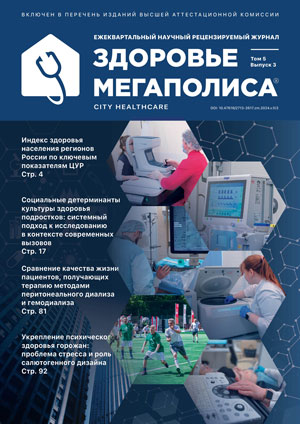
The City Healthcare Journal (Zdorov'e megapolisa) is a quarterly open-access electronic scientific peer-reviewed publication on theoretical and practical aspects of healthcare organization, public health and research related to the field.
In densely populated megacities, it is important not only to provide access to medical care, but also to ensure flexible, technologically advanced and prevention-oriented healthcare. The issues of healthcare organization, public health, and preventive medicine require careful analysis, continuous research, and a scientific approach. In this context, the City Healthcare Journal serves as a unique platform for scientific dialogue and accumulation of experience.
The City Healthcare Journal emphasizes interdisciplinarity, which is a key trend in global healthcare that has formed at the intersection of different disciplines. This interdisciplinary focus guarantees a scientific approach to healthcare organization.
The mission of the City Healthcare Journal is to adhere to the principles of “4P medicine”:
Personalized healthcare. Our goal is to promote research papers and publications that focus on personalized approach to the prevention and treatment of diseases.
Preventive healthcare. Other crucial goal is to raise the awareness about preventive strategies in healthcare. We publish studies that focus on risk factors, methods for early detection of diseases and ways to increase population literacy in terms of healthy lifestyle.
Participatory healthcare. We welcome articles aimed at analyzing the role of patient involvement in preventive activities and measures that increase health consciousness.
Predictive healthcare. We are interested in publishing articles on data analysis methods, AI in medicine, technologies forecasting population health, and constructive communication with patients.
The journal is indexed in the Russian Science Citation Index (RSCI) and is also part of the list of peer-reviewed scientific publications recognized by the Higher Attestation Commission under the Ministry of Science and Higher Education of the Russian Federation (VAK) in three scientific specialties (and their corresponding branches of science), according to which the academic degrees of Cand. Sci. (Candidate of Sciences) and Dr. Sci. (Doctor of Sciences) are awarded:
3.2.3. Public health, organization and sociology of health (medical sciences);
5.2.3. Regional and sectoral economics (economic sciences);
5.4.4. Social structure, social institutions and processes (sociological sciences).
The journal is connected to the international system of bibliographic references CrossRef and assigns DOI and Crossmark digital identifiers free of charge to all scientific works, provides full-text archiving of publications and their metadata in Russian and English on the Cyberleninka and eLIBRARY platforms, included in international databases.
The journal is listed in the current VAK list under No. 1167 (dated February 05, 2025).
Current issue
ORIGINAL RESEARCHES
Objective. To evaluate the impact of a series of organizational measures for implementing innovative medical technology in a multidisciplinary hospital on patient quality of life based on patient self-assessments. Results. Patients who received care using innovative medical technology within a systemic organizational approach demonstrated a significantly higher level of overall satisfaction with the quality of care. The average score in this group was 4.67 (out of a possible maximum of 5.0), compared with 3.97 among patients treated according to routine protocols. The difference between the groups is statistically highly significant (p = 0.0000152, Mann-Whitney test), confirming that patients perceive higher standards of care organization and delivery when innovations are implemented comprehensively. The key integral indicator–change in overall quality of life–also showed a significant gap between the groups. Patients in the study group rated their quality-of-life improvement at an average of 4.36 points, while the average score in the control group was 3.88 points. Conclusion. The findings indicate that the implemented set of organizational measures and medical technology improves both patients’ health outcomes and social and psychological well-being in patients after receiving care.
Purpose. To study the use of digital technology for preventing cardiovascular diseases. Materials and methods. A survey was conducted among 477 respondents who used the digital technology–a pre-hospital preventive care tool for self-assessment of cardiovascular risks. Biological, behavioral, and organizational risk factors affecting health as well as active patient participation in own care were assessed. Results. The authors identified the individuals who had not visited a polyclinic for more than 12 months (17.4%) and more than 24 months (7.1%), thus not examined by healthcare professionals, including those who work at preventive health units (departments). Self-surveys at the pre-hospital stage revealed a high or very high absolute total cardiovascular risk in 31.1% of respondents. According to the survey, healthcare professionals provided preventive health recommendations to 59.7% of the sample, while using the digital technology, 100% of respondents received personalized lifestyle recommendations. A satisfactory level of participation was determined. The greatest interest in using the digital technology was observed among individuals aged 18-39 years (58.9%). Conclusion. The digital instrument Cardiovascular Prevention in Your Pocket (Kardioprofilaktika v karmane) enables the implementation of the 4P medicine at the pre-hospital level of care. The technology generates preventive health recommendations and identifies cardiovascular risk (predictive and preventive), creates tailored preventive health recommendations (personalized), and promotes the involvement of respondents in their own care without support of healthcare professional (participatory).
Background. Dental caries is a major cause of concern in school-age children, especially in low-income countries. It is established that socioeconomic factors, nutrition, and access to prevention services all influence to the prevalence of caries, but there is little local evidence on this subject in the Mardan District. Aim. To investigate the association between socioeconomic status, fluoride varnish use, nutritional status, and dental caries prevention among school-age children in the Mardan District. Material and methods. A cross-sectional study was carried out in 400 school-age children aged 6 to 12 years. A structured questionnaire was used to collect sociodemographic data. The clinical examination was performed to estimate the dental caries status. The nutritional status was measured using BMI-for-age growth charts. The data about using fluoride varnishes was documented. Associations were analyzed using chi-square tests with statistical significance set at p <0.05. Results. The average age of respondents was 9.1±1.8 years. 52.5% of respondents were male and 47.5% female. The majority of children were in the low (38.0%) and middle (42.5%) socioeconomic classes. Children of low socioeconomic status (SES) (62.5%) had a higher prevalence of dental caries compared to those of middle and high SES (44.1 and 28.2% respectively, p < 0.001). Children who received fluoride varnish had significantly lower dental caries prevalence (32.4%) compared to those who did not received it (58.9%) (p <0.001). Underweight children had the highest prevalence of dental caries (61.8%) compared to normal-weight (41.7%) and overweight children, with statistically significant relationship (p = 0.002). Children of low SES who were underweight and did not received fluoride varnish (68.4%) and children of high SES with normal nutritional status who received fluoride varnish (21.6%) had the highest and lowest dental caries burdens, respectively. Conclusion. Dental caries in school-age children in the Mardan District are closely related to socioeconomic status, nutrition status, and use of fluoride varnish. School-based interventions promoting dental caries prevention and dental care as well as nutritional enhancement, especially among children from low socioeconomic backgrounds, should be integrated to reduce the burden of dental caries in school-aged children.
Introduction. The reproductive health of university students gains a special significance. Future physicians develop value orientations and professional competencies that directly affect the reproductive health status of the population and the effectiveness of preventive programs. Objective. To assess the level of awareness and behavioral attitudes toward reproductive health among medical students and to identify sex-related differences in these aspects. Materials and Methods. A cross-sectional anonymous survey was conducted among 236 students (70 males and 166 females, grades 1–6) at the Federal State Budgetary Educational Institution of Higher Education “Saint Luka Lugansk State Medical University of the Ministry of Health of the Russian Federation”. A self-designed questionnaire was used, covering domains including sexual experience, contraception, attitudes toward sex education, testing for sexually transmitted infections (STIs), abortion, and distribution of responsibility for reproductive health. Data were processed using descriptive statistics in Microsoft Excel 2019, ensuring representativeness with a 95% confidence level and a margin of error of ±5%. Results. Sixty-five percent of respondents reported being sexually active; female students reported sexual experience more frequently than male students. Barrier methods remain the predominant form of contraception (70.8%), despite high awareness of emergency contraception (91.5%) and a prevailing attitude toward shared partner responsibility for contraception (89%) and unplanned pregnancy (89.9%). The majority of students expressed positive attitudes toward school-based sexual education (81.8%) and regular STI testing. The proportion of respondents who supports screening increases from 64.2% among first-year students to 94.3% among sixth-year students as awareness grows in the course of medical education.
The aim of this study is to summarize current evidence‑based approaches to psychological treatment for post‑traumatic stress disorder (PTSD) and to present a reproducible comparative efficacy assessment of trauma‑focused cognitive behavioral therapy (TF‑CBT; protocols include prolonged exposure, cognitive processing therapy, cognitive therapy for PTSD, etc.) and EMDR compared to supportive counseling (treatment as usual, TAU) in a controlled trial with a moderate sample size. Materials and methods. A review of clinical guidelines and meta‑analytic data was conducted, including WHO, NICE, VA/DoD, and APA guidelines, as well as systematic reviews of the effectiveness of TF‑CBT and EMDR and real‑world data. A prospective study (N=180; 60 participants in each group) was conducted with three measurement points: before treatment (T0), after 12 weeks (T1), and after 3 months (T2). The dataset was formed using distributions of baseline indicators and change parameters consistent with published effects of trauma‑focused psychotherapies and service samples, allowing for transparent verification of all calculations and the reproducibility of the patient population. Instruments: PCL‑5 (primary outcome), PHQ‑9, GAD‑7, WHO‑5, and WSAS. Results. A significant group × time interaction was found for the PCL‑5 (LRT χ²(4)=20.68; p=0.0004). Changes from T0 to T1 differed between groups (F(2,177)=13.02; p=0.000005; η²=0.128). Compared with TAU, both trauma‑focused programs produced greater reductions in PTSD symptoms: TF‑CBT vs. TAU d=0.86 (p=0.000007), EMDR vs. TAU d=0.74 (p=0.000097); no differences were found between TF‑CBT and EMDR (p=0.564). The remission rates (PCL-5<33) at T1 were 43.3% (TF‑CBT), 46.7% (EMDR), and 21.7% (TAU); The number needed to treat (NNT) to achieve additional remission relative to TAU was 4.6 (TF‑CBT) and 4.0 (EMDR). Conclusions. Trauma‑focused psychotherapies remain the first‑line treatment for PTSD and demonstrate consistent superiority over non-specific support. A stepwise approach is feasible: standardized assessment and monitoring (PCL‑5), selection of TF‑CBT/EMDR as the primary therapy, reinforcement with skills and digital modules when access is limited, and targeted work with sleep and comorbidity, strictly following the indications.
REVIEWS
Introduction. Nutrition is one of the key modifiable determinants of aging that influences the risk of cardiovascular and metabolic diseases. In Central Asian countries, which are at early stages of the demographic transition, the interaction between traditional dietary culture and ongoing dietary changes is of particular importance. The goal of this study was to analyze the traditional dietary matrix of the region and to assess the impact of dietary transformation on aging trajectories. Materials and methods. A literature review (2000–2025) was conducted using PubMed/MEDLINE, Scopus, Web of Science, Google Scholar databases and reports from international organizations. Epidemiological, review, and regional studies addressing nutrition, non-communicable diseases, and aging in Central Asian countries were included. Results. Central Asian countries are entering a phase of demographic transition against a background of a high burden of cardiovascular and metabolic diseases, creating conditions for accelerated vascular aging. Traditional diets are characterized by the dominance of cereal products, a substantial role of meat and dairy products, and low fish consumption. At the same time, an increasing overlay of ultra-processed foods on an energy-dense traditional diet is observed, accompanied by higher intakes of salt, sugar, and saturated fats and by a deterioration in cardiometabolic profiles. Conclusion. Dietary transformation in Central Asia may contribute to accelerated cardiometabolic and functional aging, underscoring the need for culturally sensitive adaptation of traditional diets with reduced consumption of ultra-processed foods and improved nutritional density.
Introduction. Asymptomatic individuals account for almost 34% of all atherosclerosis-related deaths. Prognostic data says that cardiovascular diseases, chronic obstructive pulmonary disease, and lung cancer will continue to dominate the overall structure of causes of death until 2050. These conditions form the Big-3 Group, imposing a significant socioeconomic burden on the healthcare systems of most countries. CT-based methods enable the diagnosis of Big-3 diseases at the latent stage. It is suggested that single screening for multiple diseases (Big-3 screening) performed within one chest CT scan session improves the efficiency of examination at minimal additional cost. The economic potential of Big-3 screening has been demonstrated in early-stage technology assessments. Materials and methods. The authors analyzed CT innovations for coronary calcium scans, current AI-driven approaches to integrating combined protocols for CT imaging, and clinical effectiveness and cost-effectiveness of implementing these tools. Results. Advanced technology, such as dual-source computed tomography (DSCT) and photon-counting computed tomography (PCCT), showed a high reproducibility of coronary calcium screening results. These techniques allow the reliable evaluation of calcium score using the protocol for non-ECG-gated low-dose computed tomography (LDCT). Medical centers not equipped with high-resolution CT scanners can use AI algorithms instead. Such algorithms enhance the automatic grading of coronary calcium severity while also assessing the quality of images, validating the reliability of results, and making decisions on next steps in the patient journey, including further standard imaging tests. Conclusion. The optimization of protocols for CT screening, as well as patient inclusion and exclusion criteria, must be guided by the results of clinical trials and mathematical modeling. This will balance clinical and economic benefits against iatrogenic risks, thereby establishing the feasibility of coronary artery calcium screening within BIG-3-type strategies.
Introduction. Burnout syndrome is a condition caused by excessive workplace stress, and physicians and other healthcare professionals are at risk due to numerous occupational factors. Studies comparing burnout rates among physicians and other professions show that physicians consistently experience higher burnout rates. The observed high prevalence highlights the need to develop methods to build resilience and manage burnout in physicians. The goal of this study was to analyze the international literature describing effective programs aimed at combating burnout in healthcare workers, contributing to their mental health and quality of life. Materials and methods. A search of scientific literature in the international PubMed/MEDLINE database was conducted. We selected articles published over the past five years describing programs for combating burnout in healthcare workers that had proven effective. The results showed a variety of methods for improving physicians’ mental health, including individual approaches such as physiotherapy and psychotherapy, mindfulness training, various yoga techniques, coaching, and small group discussions. Clinical studies with control groups have confirmed their effectiveness. The tailored adaptation of these methods and the use of digital technologies make the sessions accessible and convenient for healthcare workers.
Introduction. Adjustment disorders (AD) occupy a vast but poorly understood niche in the spectrum of social stress disorders. Despite their high prevalence, their clinical significance has long been underestimated due to blurred diagnostic criteria. Objective. To summarize current data on AD with a focus on diagnostic evolution, epidemiology, social significance, mechanisms of formation, and therapeutic strategies. Material and methods. Publications indexed in eLibrary.ru, PubMed, Scopus, and RSCI (2010–2025) were analyzed. The review includes 59 sources. Results. In ICD11, AD is operationalized through the symptoms of “preoccupation with the stressor” and “failure to adapt” with a time criterion of one month. In outpatient practice, AD accounts for 5–21%; in social risk groups – 15–35%; among military personnel evacuated from combat zones – 37.6%. Russian researchers have confirmed the role of neuroimmunoendocrine disturbances as an etiological factor. Cognitive behavioral therapy is most effective; pharmacotherapy is adjunctive but widely used in practice. Suicidal risk in AD is high: the risk of suicide attempts is increased 4.7fold, and the risk of completed suicide – 6fold. Conclusions. AD is an independent clinical category requiring a personalized approach and close attention from clinicians, especially in the context of social changes.
TRENDS AND ANALYTICS
Introduction. The optimization of global healthcare systems in response to the challenges of recent decades, including the COVID-19 pandemic, the increasing burden of chronic diseases, population aging, and rapid advances in biomedical technologies, clearly highlight the need to shift from traditional models of healthcare delivery to innovative approaches. This article examines the key concepts of healthcare transformation: value-based healthcare (VBHC) and high-value health systems (HVHS). It analyzes their interrelationships, similarities and differences, and the experience of their practical implementation globally. Key considerations for the Russian Federation in the context of the transition to HVHS are highlighted. The goal was to carry out a comparative analysis of VBHC and HVHS and examine their relationship and evolution, as well as to study the global experience of their implementation for further elaboration of a competitive healthcare system in Russia. Materials and methods. To achieve the study's goals, a combination of general scientific research methods was used: systematization and conceptual analysis, comparative analysis, generalization, and descriptive and analytical synthesis. The study relied on data obtained through content analysis of scientific publications published in open data sources, including PubMed, Springer Nature, and eLibrary.ru from January 1, 2020, to September 1, 2025. The keywords “value-based healthcare” and “healthcare systems” were used in the search. Results. The analysis revealed a clear evolutionary trajectory from the VBHC model focusing on individual diseases to the systemic HVHS paradigm encompassing all healthcare. A comparison of the concepts revealed their complementarity: the VBHC model functions as a tactical tool at the healthcare delivery level, while HVHS represents a strategic framework at the macro level. Global experience shows that no country has fully implemented all components of these models. In the context of the Russian Federation, uneven progress has been noted.
LESSONS FROM THE PAST FOR THE MEDICINE OF TOMORROW
Introduction. The article provides a detailed historical organization study of the development of the anatomical pathology services in Russia. It covers the period from 1706, when the first anatomical theater was established by the decree of Peter the Great, to the present day, when new regulations are adopted. The author specifically focuses on analyzing the evolving anatomical pathology practices and studying the legal acts governing the anatomical pathology services in different historical periods. Purpose. To conduct a historical organization study of the development of the anatomical pathology services in Russia in order to identify long-standing challenges and then improve the services relying on historical experience. Materials and methods. The author performed a historical and comparative analysis and logical analysis. A content analysis of official documents and archival sources was also carried out. Results. The author provided the periodization of the evolution of anatomical pathology services, dividing it into three main time periods: autopsy (16th to 19th century), microscopic studies (19th century to early to mid-20th century), and molecular diagnostics (mid-20th century to the present). Conclusion. Today’s anatomical pathology services in Russia face a number of systemic and persistent challenges, which have unsolved throughout history and are addressed less efficiently than the issues in other medical specialties, despite the long history of transforming clinical practices and regulatory frameworks.
EXPERIENCE EXCHANGE
In the context of growing medical tourism sector and increasing migration flows, Russian healthcare system faces the need to provide care to patients whose cultural and religious identity has been shaped under the influence of ancient spiritual traditions. As one of the oldest monotheistic religions that retains influence in Iran, India and the Diaspora countries, Zoroastrianism is of particular interest to medical anthropology. Lack of knowledge of the behavioral patterns of Zoroastrians in relation to medical care provision can create barriers to doctor-patient interaction. The purpose of the study was to systematize the socio-cultural and religious characteristics of Zoroastrian patients and develop practice-oriented recommendations for medical professionals. Materials and methods. A comprehensive analysis of religious primary sources, scientific literature, and modern anthropological studies of Zoroastrianism and its influence on health and disease patterns was carried out. Results. The key aspects of the Zoroastrian worldview relevant to clinical practice have been identified. Structured recommendations for providing culturally sensitive care have been developed. Conclusion. The integration of knowledge about Zoroastrianism into clinical practice contributes to cross-cultural competence of medical personnel, increases the effectiveness of their interaction, and complies with the principles of value-based care.
Background. Today, social media analytics is a relevant and promising method in social research. Trends in using analytical results indicate that they are increasingly seen as a reflection of public consciousness. At the same time, research that explores social media analytics from the perspective of public consciousness lacks a theoretical basis. This article responds to this need. Objective. To provide a theoretical framework that identifies conceptual intersections and differences between social media analytics and traditional quantitative survey methods—which are better understood in terms of representing public consciousness— across six axes. Results. The following axes were determined using general logical methods and by literature review of healthcare studies: freedom of expression / formalization; immersion in digital infrastructure (sampling bias based on accessibility); motivation and depth of engagement (expertness); means of expression (number of modalities); time (temporal dynamics and retrospectivity); and the specific features of authors/ respondents. For the latter axis, an approach is provided based on the representation of people with specific socio-psychological profiles in samples and/or belonging to distinct information bubbles. Conclusion. A figure where survey correlates with social media data is presented. A number of framework’s principles are supported by arguments, and future research directions for its validation are outlined.
PUBLICATIONS OF N.A. SEMASHKO NATIONAL RESEARCH INSTITUTE OF PUBLIC HEALTH
Introduction. The article examines the influence of demographic factors on perception of artificial intelligence (AI) technologies. The relevance of the study comes from the fact that public acceptance of AI depends not only on the characteristics of the technologies themselves but also on the socio-demographic characteristics of various population groups. The aim is to reveal the role the demographic factor plays in the perception of artificial intelligence technologies. Materials and methods. The study is both theoretical and analytical in nature. International sociological surveys and modern academic publications on public perception of AI are used as an empirical basis. The methodological basis includes comparative analysis, and scientific generalization and interpretation of secondary data, which allowed to compare the results of mass research and scientific research, revealing the influence of demographic characteristics on attitudes towards AI. Results. The study finds that perceptions of AI vary significantly by demographic parameters. The most pronounced differences are related to age: younger groups tend to show a higher level of awareness, engagement, and willingness to use AI, while older age groups are more wary and less confident technology-wise. Sex and education level also influence the level of trust in AI, as well as the perception of its risks and benefits, while socio-economic status either increases or decreases the digital environment involvement. Demographic variables do not act in isolation but combine with digital experience, AI competence, and professional context. Conclusion. It is necessary to take the demographic heterogeneity into account in order to develop effective strategies for public outreach, AI literacy development, and a more sustainable introduction of artificial intelligence technologies.
Background. Mentoring in the healthcare system is a mechanism for onboarding new employees, developing professional competencies, and ensuring the continuity of practical skills. Digital mentoring is a promising direction for developing HR strategy in outpatient healthcare organizations because it combines traditional mentoring methods with digital environment advantages: remote support, online educational resources, video consulting, digital checklists, online monitoring of individual progress, and exchange of experience between departments of a healthcare organization. Objective. To theoretically substantiate the need for introducing digital mentoring into outpatient healthcare organizations and to determine key organizational conditions for its successful implementation in human resource development for primary health care providers. Materials and methods. The author used systematic, organizational and managerial, and competence-based approaches. Using a systematic approach, digital mentoring was viewed as part of the healthcare organization’s HR strategy. The organizational and managerial approach was used to analyze the conditions for integrating digital mentoring in outpatient care. The competence-based approach was used to consider digital mentoring as a tool for strengthening professional and digital competencies of healthcare professionals. Results. Introducing digital mentoring into outpatient healthcare organizations is a core focus area for enhancing HR strategy and quality management in healthcare. Digital transformation in healthcare, complex professional requirements for healthcare professionals, health information system development, as well as the adaptation of young professionals to the heavy workload in primary healthcare all contribute to the importance of digital mentoring. Digital mentoring enables more flexible and consistent support for the mentee, especially in the setting of a fragmented outpatient care structure. However, digital mentoring should not substitute face-to-face professional interactions.
Introduction. One of the key factors influencing professional motivation in healthcare workers is their financial compensation and its fairness upon calculation. The need to develop staff incentives is further justified by the fact that their implementation boosts work productivity and creates additional opportunities for attracting and retaining highly qualified professionals. The aim is to analyze the efficiency of the incentives in place. Materials and methods. The research employed a desk research method called the review of scientific literature on the subject. Results. The issue of introducing efficient incentives for primary care medical staff remains of great significance from both scientific and practical point of view, since it is directly linked to the quality of healthcare delivery, workforce stability, and the overall functioning of the healthcare system. Developing an effective incentive model requires not only implementing specific reward measures, but also considering healthcare workers’ underlying needs, professional values, life attitudes, and their perception of fairness in employment relationships.
Introduction. The relevance of this research is determined by the need for a scientific understanding of the media producing concept for medical organizations. Unlike traditional marketing, which focuses primarily on promoting services, producing involves a comprehensive organization of media processes: developing a concept for the public presence of a medical organization, creating expert content, coordinating specialists, conducting a legal review of messages, selecting media channels, implementing reputational risk management, and evaluating communication results. Objective. To provide insights into the producing of medical organizations in the media marketing system. Materials and methods. The article is theoretical and analytical in its nature. The study uses official documents of the World Health Organization, regulatory legal acts of the Russian Federation on health protection, advertising, personal data and the provision of paid medical services, as well as scientific publications on social media and digital marketing in healthcare. Results. The producing of medical organizations in the media marketing system is an independent area of management at the intersection of medical management, digital communications, marketing, law, and professional ethics. Producing in healthcare is aimed at promoting medical services as well as establishing a reliable, socially responsible and legitimate media presence of a medical organization.
VIEWS AND DISCUSSIONS
Introduction. In the context of digital transformation, digital literacy is becoming a prerequisite for social inclusion, access to services, and full participation in economic and social life. At the same time, age remains one of the most persistent factors of digital inequality, which determines the relevance of studying differences in digital literacy among various age groups and the issue of digital divide. The aim was to analyze the differences in digital literacy among various age groups as well as to assess the digital divide as a social and institutional problem. Materials and methods. The research is theoretical and analytical in nature and is based on an analysis of scientific literature, international analytical reports and statistical materials on digital literacy, digital skills, and age-related aspects of digital inequality. The paper uses methods of analysis and generalization of scientific sources, a comparative analytical method, a systematic approach and content analysis of publications on digital literacy of various age groups. Results. It has been established that digital literacy in modern science is interpreted as a multicomponent characteristic, including knowledge, skills, motivation, security and the ability to act effectively in a digital environment. It is shown that the highest level of digital inclusion is typical for young people, while older age groups are more likely to face a lack of digital skills, limited confidence in the use of technology, and an increased risk of social exclusion. It has been revealed that the digital divide has a multi-level character and manifests itself not only in differences in access to the Internet and devices, but also in skill levels, the intensity of technology use and the ability to obtain practical benefits from participation in the digital environment. It is concluded that there is a need for an integrated approach to bridging the digital age gap, including the development of digital infrastructure, continuous learning, intergenerational support, and the adaptation of digital services to the needs of different age groups.
The article discusses insurance and non-insurance cases of glaucoma treatment within the Russian Compulsory Health Insurance (CHI) system, addressing glaucoma as an eye disease that generally refers to a group of conditions covered within the basic CHI program, including primary health care and specialized medical care in accordance with the Program of State Guarantees of Free Medical Care, procedures, standards, and clinical recommendations. The study demonstrates that the differentiation between insured and non-insured glaucoma cases depends not only on the diagnosis but also on the legal status of the patient, care setting, indications and validation of a treatment against the Program of State Guarantees. In conclusion, in order to confirm the eligibility of a glaucoma treatment, it is necessary to take into account the connection between the Federal Law on Compulsory Health Insurance, the Program of State Guarantees of Free Medical Care, legislation on public health protection, and current glaucoma clinical guidelines.
Announcements
2026-07-09
The City Healthcare Journal has now the L2 ranking in the White List
The City Healthcare Journal has strengthen its position, being included into the second level (L2) of the national journal ranking in 2026. This became known from an updated version of the Unified National State of Scientific Publications, or so called the White List, that the Russian Center for Science Information has recently published.
This event reflects the Journal’s scientific significance, transparent editorial processes, as well as high quality of published research. We express our deepest gratitude to all authors and reviewers of our Journal for substantial contributions.
The City Healthcare Journal is an open access resource. You can find its archives at our website. To submit a manuscript, please fill out the online form “Start submission” (require prior registration): https://www.city-healthcare.com/jour/author/submit/.
| More Announcements... |